






As customer journeys become more complex, lead qualification AI offers a smarter way to evaluate interest and intent. It helps businesses move beyond guesswork and focus on leads that show real potential to convert.
Introduction
When an organization uses an automated customer service system, it can easily streamline how it handles leads. Not only does this improve accuracy, but it also ensures that every single customer interaction genuinely adds value.
The Challenge of Qualifying Leads in Modern Sales
Lead qualification is essentially the process of evaluating prospective customers to determine their interest, their budget, who has the authority to approve a purchase, and the timing of their need. This step is crucial because it ensures that sales teams focus only on the leads most likely to convert into actual customers.
Traditional methods, however, involve tedious manual data entry, inconsistent scoring, delayed follow-ups, and subjective judgments. This approach often wastes valuable time and ultimately lets good leads go cold.
Introducing AI in Lead Qualification
Artificial Intelligence (AI) is a powerful tool that analyzes data, learns patterns, and makes decisions without needing constant human intervention, meaning it efficiently automates repetitive tasks. In the world of lead qualification, AI assesses behavioral, firmographic, and demographic data to score leads in real-time. This helps companies route leads much faster, reduce errors, and promptly forward the right leads to sales.
Understanding Lead Qualification AI
What is Lead Qualification AI?
Lead Qualification AI uses various machine learning and analytics tools to score leads with data on website visits, downloaded content, engagement metrics, company size, job title, and other firmographic dimensions to predict the likelihood of conversion. Unlike rule-based automation, which depends on fixed conditions - like “If the job title is manager and the budget is over $10K, then add +10 points” - AI doesn’t stop there. Real AI-powered systems go way beyond those static rules. They learn from past results, adjust how much each signal matters, and can even spot important patterns that humans might overlook.
Key Technologies Powering Lead Qualification AI
The ML models are trained on historical conversion data to predict future patterns. As an example, leads that downloaded X and visited the Y page might be three times more likely to convert. NLP helps a system understand text-based data, such as emails or chat transcripts, by extracting intent and sentiment to inform lead scoring.
Predictive analytics ties everything together, combining historical data with real-time inputs to forecast the readiness of a lead, prioritize, and route it to the right sales reps. This approach gives teams a real "first-mover" advantage.
How AI Qualifies Leads: The Process
It works by gathering data from different places - like your CRM, marketing tools, and website analytics - so you get a clear picture of how each lead behaves. Before the model can be trained, things like page visits, time spent on site, and job titles need to be cleaned up and organized.
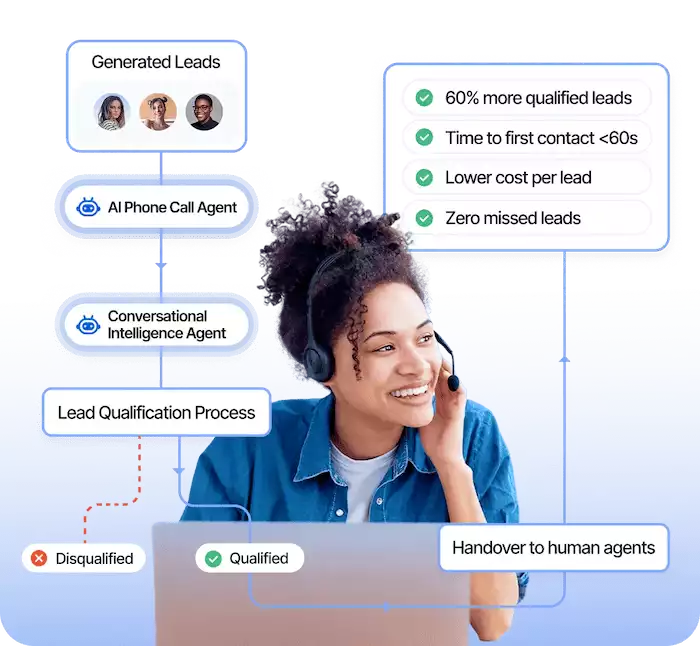
The system then studies past data, comparing leads who converted with those who didn’t. This helps train the algorithm, check its accuracy, and fine-tune its predictions. Once it’s running, the AI scores leads in real time: high-scoring ones go straight to the sales team, while lower-scoring ones move into nurturing campaigns. This way, follow-ups happen faster, and sales teams can spend time on the leads that really matter.
With Botcake, this process happens instantly through live chat on platforms like Facebook Messenger or WhatsApp. The AI bot asks friendly, natural qualifying questions - such as budget, needs, or timeline - scores each lead based on their answers, and then routes qualified leads to sales teams right away, without delays.
Benefits of Implementing AI in Lead Qualification
Enhanced Accuracy and Efficiency
AI makes lead scoring faster and more accurate by doing the work automatically and removing human bias. It can go through thousands of leads in just seconds to find out which ones are most likely to convert. What used to take hours for each lead can now be done in just a few minutes.
Improved Sales Productivity and Focus
In addition, low-value leads can be filtered out automatically, and sales teams can deal only with high-potential leads. AI can help with the routine tasks of scoring, routing, logging initial outreach, and follow-ups to make the process leaner, smoother, and far more focused.
Higher Conversion Rates and Revenue Growth
Focusing on the right leads at the right time significantly improves conversion rates, with some companies reporting up to 300% gains. Rather than spreading effort and budget evenly, organizations can invest resources into quality leads only.
Deeper Customer Insights
AI models track lead behavior continuously, including pages visited and actions taken, helping businesses to build a detailed view of their high-value prospects. These are key points that help teams create personalized messages, offers, and experiences that better resonate with each of their leads, thus increasing their engagement and conversions.
Implementing Lead Qualification AI: A Step‑by‑Step Guide
Assessing Your Current Lead Qualification Process
Start by mapping your current workflow: How many leads do you handle? What percentage actually converts? Where are the bottlenecks - delays, inconsistent scoring, or manual errors? Next, you have to set specific goals like reducing lead processing time, improving routing accuracy, or increasing conversion rates. These benchmarks will guide your AI implementation.
Choosing the Right AI Solution
Now you have to choose whether to build a system yourself or to use one provided by a third party. In-house development is good at flexibility but requires data science and engineering resources, whereas third-party solutions allow for fast deployment but are likely less flexible. Look for solutions that integrate with your CRM and marketing tools, allow scoring rule customization, provide analytics dashboards, and support real-time lead routing.
Data Preparation and Integration
Clean your data by removing duplicates, standardizing formats, filling in missing values, and aligning definitions - like what counts as a “lead.” Poor data quality undermines AI performance. Then, ensure all lead capture, CRM, marketing automation, and analytics tools feed smoothly into your AI system, so real-time scoring and routing work seamlessly.
Training, Optimization, and Workflow Integration
Training, Optimization, and Workflow Integration Train the AI model on historical lead data (both converted and non-converted), then continuously monitor and fine-tune it based on real-world performance. At the same time, integrate AI scoring into the sales workflow by enabling automated alerts, lead assignment, and follow-up actions, ensuring sales teams can quickly interpret scores and act on high-potential opportunities in real time.
Best Practices and Considerations for Lead Qualification AI
Data Privacy and Security
You must keep your data practices in full compliance with relevant regulations like GDPR or CCPA, particularly when you are analyzing detailed customer behavior. You also need to protect sensitive information with secure storage, controlled access, and anonymization wherever possible because trust is absolutely crucial in modern business.
Continuous Optimization with Human-in-the-Loop
AI performance should be continuously monitored through key metrics like conversion rates and sales cycle length, with regular updates as customer behavior changes. At the same time, AI is designed to support sales teams—not replace them—by prioritizing leads transparently while leaving complex decisions and relationship building to humans.
Scalability and Future-Proofing
You should choose platforms that can easily handle growing lead volumes, support additional communication channels, and integrate new tools as your business evolves. Also, you have to stay updated on AI developments to maintain a competitive edge, since early adopters often gain the biggest advantage! See how Botcake’s features easily solve these problems now!
This is where Botcake truly stands out. It supports multi-channel communication, including Facebook Messenger, WhatsApp, and Instagram, so you can manage all incoming leads in one unified system. Botcake also offers seamless human-AI handover, allowing sales teams to step in at the right moment without breaking the conversation flow. As your business grows, the platform scales effortlessly - handling higher lead volumes, adding new channels, and adapting to new workflows without complex setup or heavy technical resources.
Real‑World Use Cases and Examples

B2B Sales: Identifying High‑Value Accounts
In B2B sales, Lead Qualification AI looks at new leads and scores them based on things like company size, revenue, tech stack, and how engaged they are. The high-scoring ones go straight to senior sales reps for quick follow-up, while the rest get nurtured through automated campaigns until they’re ready to buy. This approach ensures teams focus on opportunities that are most likely to convert.
E‑commerce: Predicting Purchase Intent
For e-commerce retailers, AI is an invaluable tool because it can combine behavioral signals - such as product views, items added to the cart, and return visits - with demographic data. This helps them identify shoppers who are most likely to make a purchase.
Once those high-potential customers are identified, they can receive tailored offers, personalized messaging, or faster outreach from a sales representative. This approach significantly increases the chances of conversion while saving valuable time that would otherwise be spent on low-probability leads.
SaaS Companies: Qualifying Free Trial Users
SaaS can take advantage of AI to track users’ behavior through feature usage, logins, and even support interactions. The users are given a readiness score by the AI, which then automatically routes those over a certain threshold to sales reps for personalized follow-up. Those not quite ready are whisked through an automated nurturing workflow, ensuring they get just the right guidance until they are ready to convert.
Conclusion
The future of sales truly is found in AI-enabled automation. Using an automated customer service system can totally change the game for your business. It helps you handle leads faster, focus on the ones that really matter, and give quick, personalized replies without extra effort. In today’s competitive market, that’s a huge advantage. So don’t let good leads get away - try Botcake.io now to automate your customer service and boost your conversions with just one click!